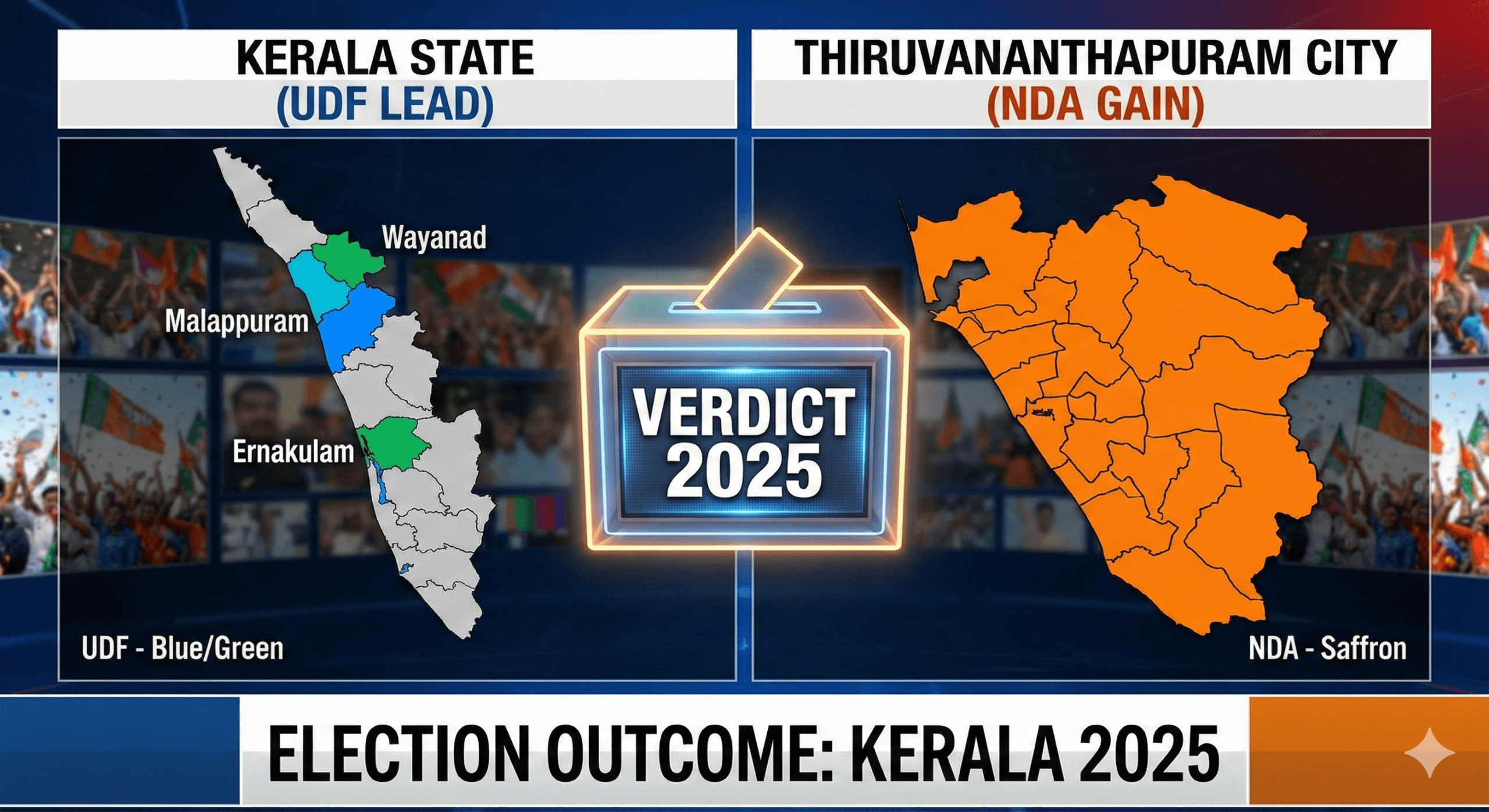
The political landscape of Kerala has undergone a dramatic transformation today. The Kerala election results for the 2025 local body polls were declared on Saturday, December 13. The outcome signals a massive shift in voter sentiment across the state.
The Congress-led United Democratic Front (UDF) has staged a spectacular comeback. They have swept the municipal corporations and regained significant ground in the rural panchayats. This victory comes as a major morale booster for the opposition ahead of the 2026 Assembly elections.
However, the most shocking development comes from the state capital. The BJP-led National Democratic Alliance (NDA) has created history in the Thiruvananthapuram Corporation. For the first time ever, the saffron party has emerged as the single largest bloc in the prestigious council.
Counting of votes began at 8:00 AM across 244 centers. Trends became clear by noon, indicating a strong anti-incumbency wave against the ruling Left Democratic Front (LDF). The results have sparked celebrations in Congress and BJP camps, while the CPI(M) offices wear a deserted look.
Historic Saffron Surge in the Capital
The biggest headline of the Kerala election results is undoubtedly the verdict in Thiruvananthapuram. The LDF had ruled this corporation for decades. That monopoly has now been shattered.
The NDA has won 49 wards in the 100-member council. They fell just short of a simple majority but are now the single largest party. This is a massive leap from their 2020 tally of 34 seats.
The ruling LDF has been pushed to a distant second spot with 32 seats. The UDF continues to struggle in the capital, finishing third with just 19 seats. This result marks a turning point in Kerala’s bipolar politics.
Political analysts attribute this surge to a consolidated vote bank. The BJP’s focus on urban infrastructure and waste management issues seems to have paid off. High-profile candidates fielded by the NDA also helped sway neutral voters.
This victory gives the BJP its first real shot at governing a major corporation in Kerala. It validates their strategy of focusing on urban centers. The Kerala election results in Thiruvananthapuram will likely force the traditional fronts to rethink their strategies.
UDF Regains Power in Kochi and Thrissur
While the capital turned saffron, the commercial hub of Kochi returned to the UDF fold. The Kerala election results for the Kochi Corporation show a landslide victory for the Congress-led front.
The UDF has secured 44 seats in the 74-member council. This gives them a comfortable majority to rule for the next five years. The LDF, which was in power, could only manage 22 seats this time.
Voters in Kochi appeared frustrated with the city’s perennial issues. Recurring waterlogging and the waste management crisis at Brahmapuram were key election themes. The UDF’s promise of a “New Kochi” seems to have resonated with the urban electorate.
In Thrissur Corporation, the story is similar. The UDF has crossed the majority mark with 33 seats. The LDF has been reduced to just 11 seats.
The NDA has also improved its position in Thrissur, winning 8 seats. The Kerala election results in these cities indicate a strong desire for change among urban dwellers. They have decisively voted against the incumbent administrators.
Rural Shift: LDF Loses Grip on Panchayats
The battle for the grassroots was expected to be tight. However, the UDF has managed to edge past the Left in the Grama Panchayats. In 2020, the LDF had swept these rural bodies.
Current trends show the UDF leading or winning in 389 Grama Panchayats. The LDF is close behind with 371 victories. This shift in rural voting patterns is significant for the Kerala election results.
Grama Panchayats are traditionally the stronghold of the CPI(M). Their cadre network usually ensures victory in these local battles. Losing control here suggests a weakening of their grassroots machinery.
The UDF’s resurgence in rural areas is being credited to active local campaigning. The consolidation of minority votes in districts like Malappuram and Wayanad also played a huge role.
The NDA has largely failed to make a dent in the rural belt. Their influence remains restricted to specific pockets in Palakkad and Pathanamthitta. The Kerala election results show that the BJP is still primarily an urban force in the state.
UDF Dominates Municipalities
The trend of UDF dominance is most visible in the Municipalities. Out of the 87 municipalities in the state, the UDF is leading in 55. This is a commanding performance compared to the last election.
The LDF is ahead in only 29 municipalities. This represents a sharp reversal from 2020 when the Left had the upper hand in semi-urban areas. The anti-incumbency factor appears to be strongest in these towns.
In the District Panchayats, the UDF has also taken the lead. They have secured 8 out of the 14 District Panchayats. The LDF has managed to hold on to 6 districts.
The UDF has swept the district panchayats of Ernakulam, Malappuram, and Wayanad. The LDF has retained its fortresses in Kannur and Palakkad.
One standout story is the performance of the Twenty20 party. They have maintained their dominance in Kizhakkambalam and neighboring panchayats. The Kerala election results prove that development-focused non-political movements still hold sway.
Anti-Incumbency and State Politics
These local body polls were widely seen as a referendum on the Pinarayi Vijayan government. The verdict suggests deep dissatisfaction with the state administration.
Several issues likely contributed to the LDF’s poor performance. The ongoing economic crisis in the state was a major talking point. Allegations of corruption and the gold smuggling controversy also dented the government’s image.
For the Congress, these Kerala election results are a lifeline. After back-to-back defeats in assembly elections, the party needed a win. This victory energizes their cadre just a year before the assembly polls.
The internal feuds within the LDF also seem to have hurt them. In many wards, rebel candidates cut into the official vote share. This lack of discipline is unusual for the Left front.





The Rise of a Third Force
The most critical takeaway from today is the rise of the BJP. By capturing the narrative in Thiruvananthapuram, they have proven they can win. The Kerala election results show a shift towards a three-cornered contest in urban areas.
The NDA’s vote share has increased significantly in corporations. While they struggle in villages, their urban growth is undeniable. This poses a threat to both the UDF and LDF in the future.
In many wards in Thiruvananthapuram, the UDF was pushed to the third spot. This suggests that the anti-LDF vote is splitting. In some cases, it is consolidating behind the BJP instead of the Congress.
Conclusion: A Semi-Final for 2026
The December 13 verdict sets the stage for the 2026 Assembly elections. The voters of Kerala have sent a loud and clear message. They are looking for a change in governance.
The UDF has proven it is still a formidable force. The LDF needs to introspect deeply to regain its lost ground. The NDA has shown it is no longer a fringe player in Kerala politics.
As the dust settles on the Kerala election results, the political heat will only increase. The battle for the state assembly has effectively begun today.
For the common man, the immediate hope is better civic amenities. With new councils taking charge, the focus will shift to governance. But politically, Kerala has entered a new and unpredictable era.
Related Disclaimer: This article analyzes the Kerala election results declared on December 13, 2025. Seat tallies are based on the latest trends from the State Election Commission and may vary slightly upon final official notification.
About the Author

📢 Click here for instant updates:
📲 Join us on WhatsApp