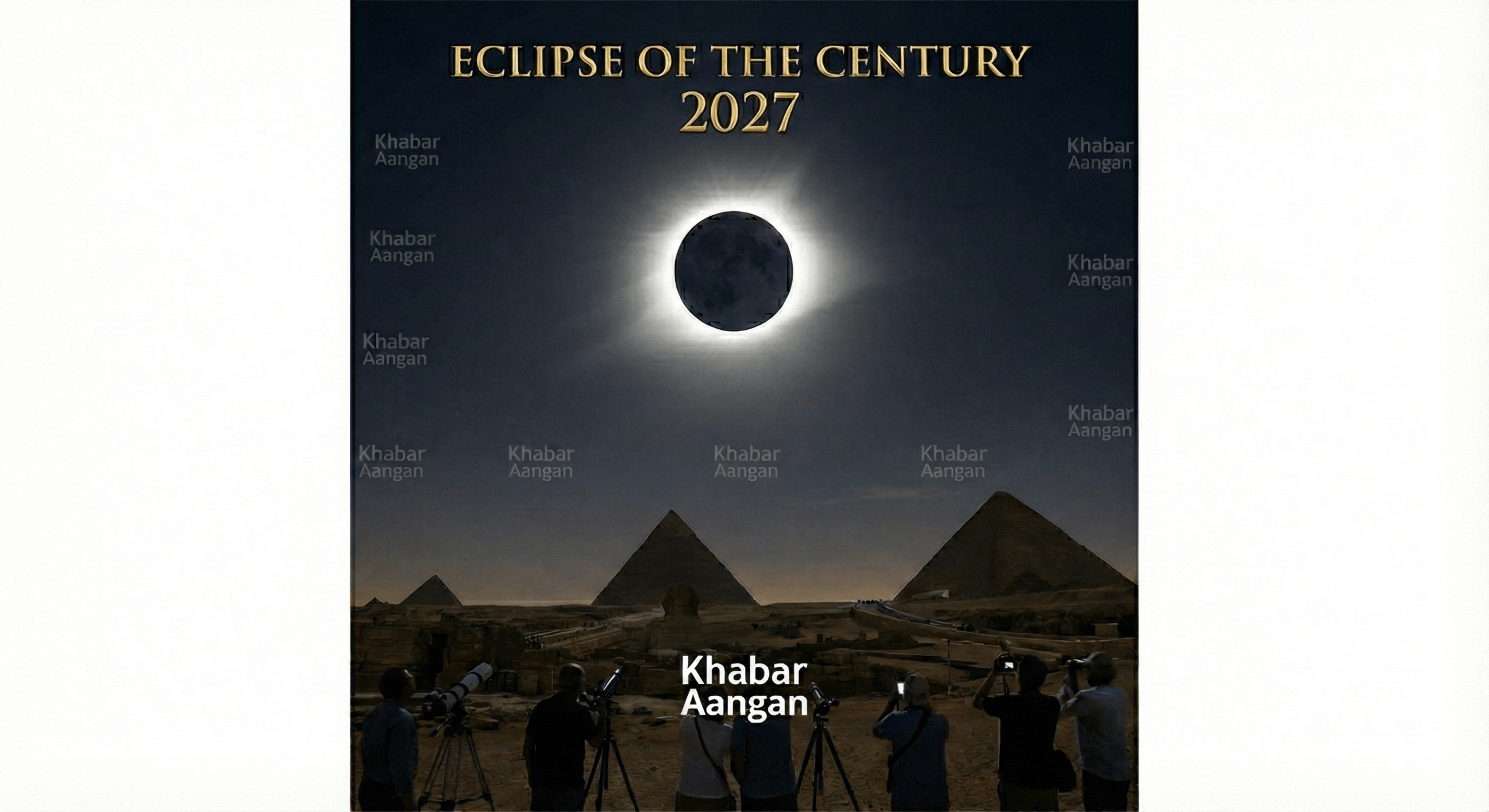
The global astronomical community has already begun its countdown to one of the most spectacular celestial events of our lifetime. On August 2, 2027, the world will witness a rare total solar eclipse that promises to be historic in both duration and visibility.
While the event is still over a year away, preparations are in full swing as of December 2025 to capture this monumental occurrence.
This upcoming solar eclipse is being hailed as the “Eclipse of the Century” by experts and enthusiasts alike. The reason for this prestigious title is the extraordinary length of totality.
At its peak, the moon will completely cover the sun for a staggering 6 minutes and 23 seconds. This duration is unprecedented for any eclipse visible from land in the 21st century.
Scientists and skywatchers are particularly excited because a solar eclipse of this magnitude offers a unique window into the mysteries of our solar system. The extended period of darkness will allow researchers to study the sun’s outer atmosphere, the corona, in detail that is usually impossible during shorter eclipses.
Why 6 Minutes and 23 Seconds Matters
To understand the significance of this event, one must compare it to recent eclipses. The “Great American Eclipse” of 2017 had a maximum totality of just 2 minutes and 40 seconds.
The 2024 eclipse, which captivated North America, lasted around 4 minutes. The August 2, 2027 solar eclipse will far surpass both, offering nearly double the viewing time.
Such a long duration is extremely rare. It occurs due to a perfect celestial alignment where the Earth is near its farthest point from the sun (aphelion) and the moon is near its closest point to Earth (perigee). This makes the moon appear slightly larger than the sun in our sky, creating a wide shadow and a prolonged period of darkness.
For photographers and data scientists, this extra time is invaluable. It means more time to adjust instruments, capture high-resolution images of the solar corona, and conduct experiments without the frantic rush that usually accompanies a solar eclipse.
Luxor: The Center of the Action
While the path of the solar eclipse will stretch across parts of the Atlantic Ocean, Southern Europe, and the Middle East, all eyes are on North Africa. Specifically, the ancient city of Luxor in Egypt has emerged as the prime viewing location.
Luxor sits almost directly on the centerline of the eclipse path. It is here that the maximum duration of 6 minutes and 23 seconds will be observed. The prospect of watching a total solar eclipse directly above the Valley of the Kings and the Karnak Temple has captured the imagination of travelers worldwide.
Reports indicate that hotels and cruise ships in Luxor are already seeing massive booking inquiries for August 2027. Tour operators are curating specialized “Eclipse Packages” that combine history with astronomy. The clear desert skies of Egypt in August offer an almost 100% chance of cloud-free viewing, making it the safest bet for chasers.
The Path of Totality: Which Countries Will See It?
The shadow of the moon will begin its journey in the Atlantic Ocean before making landfall in Southern Spain. Cities like Cadiz and Malaga will witness a brief but beautiful totality. The shadow will then cross the Strait of Gibraltar into Morocco, sweeping across North Africa through Algeria, Tunisia, and Libya.
After passing through Egypt, the path continues across the Red Sea into Saudi Arabia, Yemen, and Somalia before ending in the Indian Ocean. In each of these regions, the solar eclipse will turn day into night, dropping temperatures and silencing local wildlife.
Millions of people live directly within this path of totality. For them, no travel is needed; they simply need to step outside. However, for the billions outside this narrow strip, the event will be visible only as a partial solar eclipse.
Scientific Experiments and Solar Research
For the scientific community, the 2027 solar eclipse is a major research opportunity. Space agencies like NASA and ESA are expected to coordinate ground-based observations with their solar probes. The extended totality allows for prolonged study of the solar wind and coronal mass ejections.
One of the key mysteries astronomers hope to solve is the “coronal heating problem.” Scientists are still trying to understand why the sun’s outer atmosphere is millions of degrees hotter than its surface. Data collected during the deep darkness of this solar eclipse could provide missing puzzle pieces.
Universities and observatories are already applying for grants and shipping logistics to set up temporary stations in the Sahara Desert. The dry air and lack of light pollution in these remote areas make them ideal laboratories for high-precision astronomy.
What About India? A Partial View
For skywatchers in India, the news is mixed. The total phase of the solar eclipse will not be visible from the Indian subcontinent. The path of totality passes significantly to the west of the country.
However, a partial solar eclipse will be visible across most of India in the late afternoon of August 2, 2027. The western states of Gujarat and Rajasthan will see the maximum coverage, where the moon will obscure a significant portion of the sun before sunset.
In cities like Mumbai and Delhi, the event will be visible as a “bite” taken out of the sun. While it lacks the dramatic “ring of fire” or the total darkness of totality, it remains a significant astronomical event that will be widely observed across the country.
Safety First: Protecting Your Eyes
As excitement builds, experts are reiterating the importance of eye safety. Looking directly at the sun, even when it is partially covered, can cause permanent eye damage. This rule applies to every phase of a solar eclipse except for the brief moments of total darkness during totality.
Since India will only see a partial eclipse, viewers there must use ISO-certified eclipse glasses at all times. Regular sunglasses, no matter how dark, offer no protection against the intense solar radiation.
Schools and planetariums are expected to organize mass viewing events equipped with telescopes and safe solar filters. These events serve as excellent educational opportunities to teach the younger generation about celestial mechanics.





Economic Impact and Tourism Boom
The 2027 solar eclipse is expected to generate hundreds of millions of dollars in tourism revenue for the host countries. Egypt, in particular, is positioning itself as the global capital for this event.
The influx of “eclipse chasers”—a dedicated community of travelers who fly around the world to witness totality—will boost local economies. From luxury Nile cruises to desert camps in Morocco, the hospitality sector is gearing up for a record-breaking summer season in 2027.
However, this also brings logistical challenges. Managing the crowds in sensitive archaeological sites like Luxor will require careful planning to preserve heritage while accommodating the surge of visitors.
Conclusion: A Date with Destiny
The total solar eclipse of August 2, 2027, is more than just a movement of celestial bodies; it is a reminder of our place in the universe. It brings together science, history, and the sheer beauty of nature in a way few other events can.
As astronomers fine-tune their telescopes and travelers book their flights, the world waits in anticipation. For 6 minutes and 23 seconds, the sun will vanish, and millions of eyes will look up in wonder at the “Eclipse of the Century.”
Whether you are planning to be in the shadow of the pyramids or watching the partial phase from your rooftop in India, this solar eclipse is an event you will not want to miss.
Related Disclaimer: This article discusses an upcoming astronomical event scheduled for August 2, 2027. Visibility details and scientific plans are based on current astronomical data and may be subject to local weather conditions.
About the Author

📢 Click here for instant updates:
📲 Join us on WhatsApp